Otiophora caerulea
Selected images: Click on each image to see a larger version and details of the record View all images (3)

Habit
Rocky miombo woodland
Lubuli area
Jan 2020
Photo: Nick Wightman
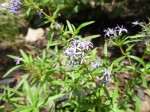
Inflorescence
Rocky miombo woodland
Lubuli area
Jan 2020
Photo: Nick Wightman

Flowers
Rocky miombo woodland
Lubuli area
Jan 2020
Photo: Nick Wightman
Detailed records: Display species records QDS maps by: Google Maps Point records by Google Maps
Species details: Click on each item to see an explanation of that item (Note: opens a new window)
| Synonyms: |
Otiophora pulchella De Wild. Pentanisia caerulea Hiern |
| Common names: | |
| Frequency: | Occasional |
| Status: | Native |
| Description: |
Erect, multi-stemmed perennial herb growing from a large woody rootstock; stems 10-45 cm long, usually unbranched, with 2 rows of hairs or occasionally hairy all over; leaves decussate or sometimes appearing whorled, lamina (18)25-55(80) x 2-12(15) mm, elliptic-lanceolate to linear, sometimes ovate, glabrous; inflorescence several- to many-flowered, head-like, 1-2.5(4) cm in diameter; calyx enlarged, foliaceous lobe(s) 1(2), 5-10 x 1-2.5 mm, linear to (elliptic) lanceolate, mostly glabrous; corolla blue to mauve or pinkish-mauve, tube (5)7-12 mm. long, filiform, glabrous, lobes (4)5-6 x 0.7-1 mm. lanceolate, sometimes a little hairy outside; filaments (3)4-5 mm. long, glabrous, anthers c. 1 mm. long; style 8-14 mm. long, stigma lobes 1-3 mm. long; fruit yellowish brown to dark-brown, subglobose; seeds dark brown, 1.2-2.5 mm. in diameter, subglobose with the dorsal side somewhat keeled. |
| Type location: |
Angola |
| Notes: | |
| Derivation of specific name: | caerulea: blue, in reference to the flower colour. |
| Habitat: | Open or wooded grasslands, sometimes in seasonally damp areas. |
| Altitude range: (metres) | 1220 - 2130 m |
| Flowering time: | Sep - Mar |
| Worldwide distribution: | Tanzania and Burundi south through DRC, Zambia and Malawi and west to Angola. |
| FZ divisions: | N,W |
| Zambian distribution (Provinces): | Nw,N |
| Growth form(s): | |
| Endemic status: | |
| Red data list status: | |
| Insects associated with this species: | |
| Spot characters: | Display spot characters for this species |
| Images last updated: | Tuesday 14 July 2020 |
| Literature: |
Burrows, J.E. & Willis, C.K. (eds) (2005). Plants of the Nyika Plateau Southern African Botanical Diversity Network Report No. 31 SABONET, Pretoria Page 245. Ntore, S. & al. (2024). Checklist of the vascular plants of Burundi Page 223. Verdcourt, B. (1988). Rubiaceae, Part 1 Flora Zambesiaca 5(1) Page 147. |
Other sources of information about Otiophora caerulea:
Our websites:
Flora of Burundi: Otiophora caeruleaFlora of Malawi: Otiophora caerulea
External websites:
African Plants: A Photo Guide (Senckenberg): Otiophora caeruleaAfrican Plant Database: Otiophora caerulea
BHL (Biodiversity Heritage Library): Otiophora caerulea
EOL (Encyclopedia of Life): Otiophora caerulea
GBIF (Global Biodiversity Information Facility): Otiophora caerulea
Google: Web - Images - Scholar
iNaturalist: Otiophora caerulea
IPNI (International Plant Names Index): Otiophora caerulea
JSTOR Plant Science: Otiophora caerulea
Mansfeld World Database of Agricultural and Horticultural Crops: Otiophora caerulea
Plants of the World Online: Otiophora caerulea
Tropicos: Otiophora caerulea
Wikipedia: Otiophora caerulea