Salacia rhodesiaca
All images: Click on each image to see a larger version and details of the record View selected images
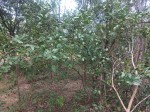
Habit
Closed regrowth miombo woodland on periphery of termitaria
Chililabombwe District
Mar 2025
Photo: Nick Wightman
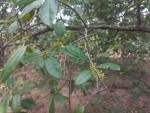
Inflorescence
Closed regrowth miombo woodland on periphery of termitaria
Chililabombwe District
Mar 2025
Photo: Nick Wightman
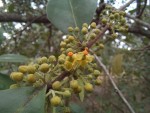
Flower
Closed regrowth miombo woodland on periphery of termitaria
Chililabombwe District
Mar 2025
Photo: Nick Wightman
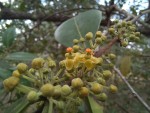
Flower
Closed regrowth miombo woodland on periphery of termitaria
Chililabombwe District
Mar 2025
Photo: Nick Wightman
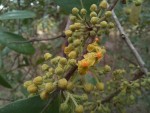
Flower
Closed regrowth miombo woodland on periphery of termitaria
Chililabombwe District
Mar 2025
Photo: Nick Wightman
Detailed records: Display species records QDS maps by: Google Maps Point records by Google Maps
Species details: Click on each item to see an explanation of that item (Note: opens a new window)
| Synonyms: | |
| Common names: | |
| Frequency: | Local |
| Status: | Native |
| Description: |
Shrub or small tree, 1.2-6 m high, with rounded crown, without latex; bark smooth; stems ± flattened with paired raised lines at first, becoming terete and rugulose, densely chocolate-brown- to fawn-pubescent. Leaves opposite to subopposite or alternate, petiolate; lamina deep dull green above (drying grey-green), markedly paler below, 3.5-13.2 × 1.5-6.1 cm, oblong to elliptic or obovate, obtuse to acute or acuminate at the apex, with margin entire or shallowly crenulate-serrulate and slightly reflexed, cuneate to rounded or rarely shallowly cordate at the base, subcoriaceous; petiole 2.5–6 mm long, with entire margins, brownish-pubescent; stipules absent. Flowers 2–16 in fasciculate axillary subdichasial or monochasial cymes, functionally dioecious, 5–7 mm in diam., sweetly scented; pedicels 2–6 mm long, articulated at the base or in the lower half; bracts 0.5 mm long, triangular, entire, red-brown, sparsely pubescent, persistent. Sepals brown, red-brown-tomentose outside, puberulous or glabrous within, c. 1 mm long, subequal, ovate to oblong, obtuse or subacute, entire, free. Petals yellow or greenish-yellow to brownish, 1.5–2 mm long, ovate to oblong, rounded, entire or with margin ciliolate, sometimes longitudinally ribbed, sparsely pubescent on both surfaces, free. Disk green, thick, convex, 5-angled, sometimes ± fluted, glabrous or puberulous. Stamens 3; in male flowers with filaments slender, equalling the style, and anthers orange, large, fertile, glabrous or ± sparsely pubescent, dehiscing by 2 oblique clefts confluent at the apex; in female flowers with filaments usually shorter than the anthers and anthers small, sterile, otherwise as in male flowers. Ovary conic, glabrous or sparsely pubescent, immersed in the disk, with style narrow, elongated in both forms of flower; stigma slightly 3-lobed; ovules 2 per loculus. Fruit red to red-brown, sometimes glaucous, c. 1.5-2.3 × 1.5-2.7 cm, globose or dorsiventrally somewhat flattened, rugulose, 2–4 seeded. Seeds cylindric. |
| Type location: |
Zambia |
| Notes: | |
| Derivation of specific name: | rhodesiaca: of Rhodesia, referring to the old British colonies of Northern Rhodesia and Southern Rhodesia. |
| Habitat: | In Brachystegia woodland or mixed dry deciduous woodland |
| Altitude range: (metres) | 1230 - 1800 m |
| Flowering time: | Feb - Jun |
| Worldwide distribution: | Angola, DRC, Gabon, Zambia, Zimbabwe and Tanzania |
| FZ divisions: | N,W,C |
| Zambian distribution (Provinces): | Nw,Cb,Lp,C |
| Growth form(s): | Shrub over 2 m, shrub under 2 m. |
| Endemic status: | |
| Red data list status: | |
| Insects associated with this species: | |
| Spot characters: | Display spot characters for this species |
| Images last updated: | Tuesday 31 March 2026 |
| Literature: |
Robson, N.K.B. (1966). Celastraceae Flora Zambesiaca 2(2) Pages 395 - 396. |
Other sources of information about Salacia rhodesiaca:
External websites:
African Plants: A Photo Guide (Senckenberg): Salacia rhodesiacaAfrican Plant Database: Salacia rhodesiaca
BHL (Biodiversity Heritage Library): Salacia rhodesiaca
EOL (Encyclopedia of Life): Salacia rhodesiaca
GBIF (Global Biodiversity Information Facility): Salacia rhodesiaca
Google: Web - Images - Scholar
iNaturalist: Salacia rhodesiaca
IPNI (International Plant Names Index): Salacia rhodesiaca
JSTOR Plant Science: Salacia rhodesiaca
Mansfeld World Database of Agricultural and Horticultural Crops: Salacia rhodesiaca
Plants of the World Online: Salacia rhodesiaca
Tropicos: Salacia rhodesiaca
Wikipedia: Salacia rhodesiaca