Aeschynomene americana
Selected images: Click on each image to see a larger version and details of the record View all images (4)
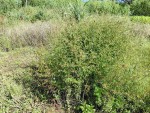
Habit
Degraded munga woodland and wooded grassland
Kitwe District
Apr 2026
Photo: Nick Wightman
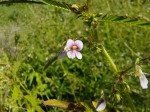
Flower
Degraded munga woodland and wooded grassland
Kitwe District
Apr 2026
Photo: Nick Wightman
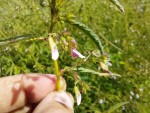
Flower
Degraded munga woodland and wooded grassland
Kitwe District
Apr 2026
Photo: Nick Wightman
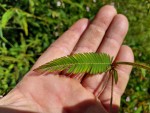
Leaf
Degraded munga woodland and wooded grassland
Kitwe District
Apr 2026
Photo: Nick Wightman
Detailed records: Display species records QDS maps by: Google Maps Point records by Google Maps
Species details: Click on each item to see an explanation of that item (Note: opens a new window)
| Synonyms: | |
| Common names: | |
| Frequency: | Locally common |
| Status: | Introduced |
| Description: |
Erect or decumbent herb, 0.3–1.5(2) m tall. Stems glandular-hispid to subglabrous. Leaves 2–7 cm long, c. 20–60-foliolate, the petiole and rhachis hispidulous; leaflets glabrous, 2–several-costate, ciliate, 4–15 × 1–2 mm, subfalcate, apiculate, the base asymmetrically rounded; stipules peltate-appendiculate, glabrous or somewhat hispid at the point of attachment, striate, usually ciliate, (5)10–25 × 1–4 mm, the upper portion attenuate, 2–3 times longer than the lower acute or erose portion. Inflorescences axillary, racemose, few-flowered, the axes hispidulous; bracts c. 2–4 × 2–3 mm, cordate, acuminate or, sometimes, truncate-flabelliform, glabrous, ciliate; bracteoles 2–4 × 1–1.5 mm, linear to linear-ovate, acute to acuminate, serrate-ciliate. Flowers c. 5–10 mm long. Calyx glabrous to hispidulous, bilabiate, 3–6 mm long. Corolla yellowish to tan, usually with red or purplish lines, glabrous. Fruit 2–3 cm long, 3–9-articulate, the stipe c. 2 mm long, the articles semicircular, the upper margin essentially straight, the lower curved, 3–6 × 2.5–5 mm, glandular-hispidulous, or glabrous or nearly so, usually muricate, the margins thickened, reticulate-veined; seeds dark brown, 2–3 × 1.5–2 mm. |
| Type location: |
|
| Notes: | |
| Derivation of specific name: | americana: of America |
| Habitat: | Degraded munga woodland and wooded grassland |
| Altitude range: (metres) | |
| Flowering time: | Mar - Jun |
| Worldwide distribution: | Native to southern North America through Central to South America but introduced and naturalised in parts of Africa, southeast Asia and northern Australia |
| FZ divisions: | W |
| Zambian distribution (Provinces): | Cb |
| Growth form(s): | Annual. |
| Endemic status: | |
| Red data list status: | |
| Insects associated with this species: | |
| Spot characters: | Display spot characters for this species |
| Images last updated: | Thursday 30 July 2026 |
| Literature: |
Verdcourt, B. (2000). Papilionoideae Flora Zambesiaca 3(6) Page 77. |
Other sources of information about Aeschynomene americana:
Our websites:
Flora of Malawi: Aeschynomene americanaExternal websites:
African Plants: A Photo Guide (Senckenberg): Aeschynomene americanaAfrican Plant Database: Aeschynomene americana
BHL (Biodiversity Heritage Library): Aeschynomene americana
EOL (Encyclopedia of Life): Aeschynomene americana
GBIF (Global Biodiversity Information Facility): Aeschynomene americana
Google: Web - Images - Scholar
iNaturalist: Aeschynomene americana
IPNI (International Plant Names Index): Aeschynomene americana
JSTOR Plant Science: Aeschynomene americana
Mansfeld World Database of Agricultural and Horticultural Crops: Aeschynomene americana
Plants of the World Online: Aeschynomene americana
Tropicos: Aeschynomene americana
Wikipedia: Aeschynomene americana