Thunbergia serpens
Selected images: Click on each image to see a larger version and details of the record View all images (3)
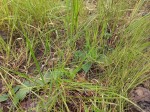
Habit
Brachystegia woodland
Tondwa GMA, Nsama District
Apr 2024
Photo: Nick Wightman
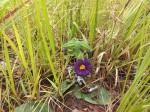
Inflorescence
Brachystegia woodland
Tondwa GMA, Nsama District
Apr 2024
Photo: Nick Wightman
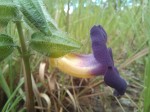
Flower profile
Brachystegia woodland
Tondwa GMA, Nsama District
Apr 2024
Photo: Nick Wightman
Detailed records: Display species records QDS maps by: Google Maps Point records by Google Maps
Species details: Click on each item to see an explanation of that item (Note: opens a new window)
| Synonyms: | |
| Common names: | |
| Frequency: | Local |
| Status: | Native |
| Description: |
Perennial herb with several trailing, sometimes rooting stems from a creeping woody rootstock with fleshy roots; stems to 75 cm long, terete or subquadrangular, with sparse to dense glossy setose hairs, rarely glabrous. Leaves palmately veined, subglabrous to pilose with glossy setose hairs; petiole 0.3–1.5 cm long; lamina ovate-oblong to elliptic or triangular-ovate, largest 8.5–18 × 4–9 cm; apex acute to obtuse, apiculate, base truncate to cordate with rounded or hastate lobes; margin entire or slightly crenate. Flowers in erect 4–8-flowered axillary racemes; peduncle and axis 5–20 cm long, glabrous to pilose with glossy setose hairs; bracts persistent, 2–7 mm long, rarely lowermost foliaceous and up to 7 × 5.5 cm, glabrous to pilose; pedicels 6–18(32 in fruit) mm long, glabrous to finely puberulous, rarely also with long glossy hairs; bracteoles pale green with conspicuous raised dark green venation, 1.8–2.8(4) × 0.6–1.5(1.7) cm, ovate-oblong to elliptic, acute to obtuse, apiculate, with long glossy capitate glands, densest along veins. Calyx glabrous, 1–3 mm long, the broadly triangular lobes about half. Corolla limb and upper part of tube deep purple-blue to deep royal blue, lower part of tube whitish, throat deep yellow; tube 2.5–4 cm long; lobes 1–1.5 × 1–2 cm, conspicuously glandular ciliate. Capsule c.8 mm wide, beak c.15 mm long. Seeds pale brown, c.7 mm in diameter with reticulate surface and a strong lateral ridge. |
| Type location: |
Zambia |
| Notes: | |
| Derivation of specific name: | serpens: creeping, referring to the habit of the stems to creep or trail along the ground. |
| Habitat: | Brachystegia woodland on sandy to loamy soil and on termite mounds. |
| Altitude range: (metres) | 1200 - 1650 m |
| Flowering time: | (Jan-)Feb - Mar(-Apr) |
| Worldwide distribution: | Zambia and DRC |
| FZ divisions: | N,W |
| Zambian distribution (Provinces): | Nw,N |
| Growth form(s): | Perennial. |
| Endemic status: | Near Endemic |
| Red data list status: | |
| Insects associated with this species: | |
| Spot characters: | Display spot characters for this species |
| Images last updated: | Tuesday 30 July 2024 |
| Literature: |
Vollesen, K. (2013). Acanthaceae (Part 1) Flora Zambesiaca 8(5) Pages 34 - 35. |
Other sources of information about Thunbergia serpens:
External websites:
African Plants: A Photo Guide (Senckenberg): Thunbergia serpensAfrican Plant Database: Thunbergia serpens
BHL (Biodiversity Heritage Library): Thunbergia serpens
EOL (Encyclopedia of Life): Thunbergia serpens
GBIF (Global Biodiversity Information Facility): Thunbergia serpens
Google: Web - Images - Scholar
iNaturalist: Thunbergia serpens
IPNI (International Plant Names Index): Thunbergia serpens
JSTOR Plant Science: Thunbergia serpens
Mansfeld World Database of Agricultural and Horticultural Crops: Thunbergia serpens
Plants of the World Online: Thunbergia serpens
Tropicos: Thunbergia serpens
Wikipedia: Thunbergia serpens