Crotalaria grandistipulata
All images: Click on each image to see a larger version and details of the record View selected images
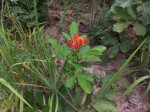
Habit
Degraded Kalahari scrubland
Kalema, Kaoma District
Jan 2024
Photo: Nick Wightman
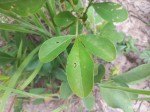
Leaf
Degraded Kalahari scrubland
Kalema, Kaoma District
Jan 2024
Photo: Nick Wightman
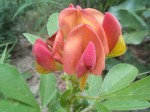
Flower
Degraded Kalahari scrubland
Kalema, Kaoma District
Jan 2024
Photo: Nick Wightman
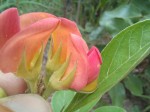
Flower
Degraded Kalahari scrubland
Kalema, Kaoma District
Jan 2024
Photo: Nick Wightman
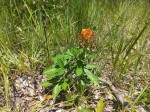
Habit
Degraded Kalahari scrubland
Muketa, Nkeyema District
Feb 2024
Photo: Nick Wightman
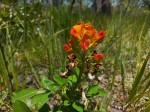
Inflorescence
Degraded Kalahari scrubland
Muketa, Nkeyema District
Feb 2024
Photo: Nick Wightman
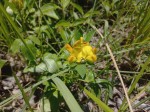
Flower Yellow
Degraded Kalahari scrubland
Muketa, Nkeyema District
Feb 2024
Photo: Nick Wightman
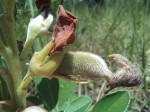
Pod
Degraded Kalahari scrubland
Muketa, Nkeyema District
Feb 2024
Photo: Nick Wightman
Detailed records: Display species records QDS maps by: Google Maps Point records by Google Maps
Species details: Click on each item to see an explanation of that item (Note: opens a new window)
| Synonyms: | |
| Common names: | |
| Frequency: | Occasional to local |
| Status: | Native |
| Description: |
Erect perennial, with 1(several) simple or sparsely branched ± sericeous-tomentose stems up to 100 cm tall, from a well developed swollen taproot. Leaves 3-foliolate; leaflets 4–12 × 1.5–5 cm, oblong-obovate, sparsely to conspicuously pubescent above, silky pubescent beneath; petiole shorter than leaflets; stipules 1.5–3.5 cm long, oblong-falcate, acuminate, very unequal-sided. Racemes terminal, subdense, becoming lax, mostly 8–15-flowered; bracts up to 11 mm long, ovate, caudate, caducous. Calyx 1.2–1.6 cm long, densely silvery pubescent; lobes free, attenuate-triangular, 2–3 times as long as the tube. Standard subcircular, yellow, tinged and fading reddish-orange, glabrous outside; wings broadly oblong, exceeding the keel; keel 1.9–2.1 cm long, abruptly rounded near the middle, with a rather short practically straight beak, lanate towards the upper edge. Pod 3–4.5 × 1.2–1.5 cm, shortly stipitate, broadly cylindrical, velvety tomentose, mostly 14–18-seeded. Seeds 5–5.5 mm long, oblong-reniform, smooth or granulate, brownish, tinged orange-red. |
| Type location: |
Tanzania |
| Notes: | |
| Derivation of specific name: | grandistipulata: with large stipules, a reference to the large stipules 1.5-3.5 cm long. |
| Habitat: | Miombo woodland, sometimes at grassy edges or near dambos |
| Altitude range: (metres) | 1100 - 1750 m |
| Flowering time: | Jan - Mar |
| Worldwide distribution: | Angola, DRC, Zambia, Zimbabwe, Malawi and Tanzania |
| FZ divisions: | B,N,W,C |
| Zambian distribution (Provinces): | Nw,Mc,C,W |
| Growth form(s): | Perennial. |
| Endemic status: | |
| Red data list status: | |
| Insects associated with this species: | |
| Spot characters: | Display spot characters for this species |
| Images last updated: | Thursday 8 May 2025 |
| Literature: |
Drummond, R.B. (1972). A list of Rhodesian Legumes. Kirkia 8(2) Page 218. Mapaura, A. & Timberlake, J. (eds) (2004). A checklist of Zimbabwean vascular plants Southern African Botanical Diversity Network Report No. 33 Sabonet, Pretoria and Harare Page 47. Martins, E.S. et al. (2003). Papilionoideae Flora Zambesiaca 3(7) Pages 108 - 109. |
Other sources of information about Crotalaria grandistipulata:
Our websites:
Flora of Malawi: Crotalaria grandistipulataFlora of Zimbabwe: Crotalaria grandistipulata
External websites:
African Plants: A Photo Guide (Senckenberg): Crotalaria grandistipulataAfrican Plant Database: Crotalaria grandistipulata
BHL (Biodiversity Heritage Library): Crotalaria grandistipulata
EOL (Encyclopedia of Life): Crotalaria grandistipulata
GBIF (Global Biodiversity Information Facility): Crotalaria grandistipulata
Google: Web - Images - Scholar
iNaturalist: Crotalaria grandistipulata
IPNI (International Plant Names Index): Crotalaria grandistipulata
JSTOR Plant Science: Crotalaria grandistipulata
Mansfeld World Database of Agricultural and Horticultural Crops: Crotalaria grandistipulata
Plants of the World Online: Crotalaria grandistipulata
Tropicos: Crotalaria grandistipulata
Wikipedia: Crotalaria grandistipulata