Gladiolus serapiiflorus
All images: Click on each image to see a larger version and details of the record View selected images
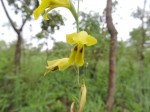
Plant found growing by the roadside amid grasses;
Lusaka National Park;
Jan 2016
Photo: Nick Wightman
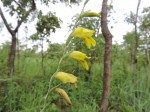
Plant found growing by the roadside amid grasses;
Lusaka National Park;
Jan 2016
Photo: Nick Wightman
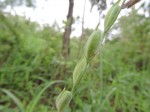
Plant found growing by the roadside amid grasses;
Lusaka National Park;
Jan 2016
Photo: Nick Wightman
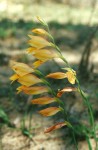
Miombo woodland
Kafue Fisheries
Nov 2002
Photo: Mike Bingham
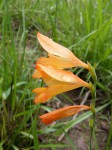
Floodplain grassland
Kafue Flats, Brian Doughty’s farm
Dec 2008
Photo: Mike Bingham
Detailed records: Display species records QDS maps by: Google Maps Point records by Google Maps
Species details: Click on each item to see an explanation of that item (Note: opens a new window)
| Synonyms: | |
| Common names: | |
| Frequency: | Local |
| Status: | Native |
| Description: |
Plants 30-60 cm tall; corms 15-20 mm in diameter, tunics pale straw-coloured, fibres reticulate; foliage leaves of the flowering stem 4-6, almost entirely sheathing or lower leaves laminate with blades 3-8 (30) cm long, linear (lanceolate), margins and midribs hyaline and slightly thickened, upper leaves predominately sheathing; flowering stem unbranched; spike 4-8(12) flowered; bracts 10-14 mm long, green becoming dry above, inner somewhat shorter to nearly as long as outer; flowers dull to bright yellow; perianth tube 7-8 mm long, curved outwards between the bracts and widening near the mouth; tepals unequal, uppermost c. 13 x 7-10 mm, arched over stamens, lower 3 tepals c. 10 mm, usually exceeding the upper tepals when viewed in profile; capsules 12-15 mm long, ellipsoid. |
| Type location: |
Zambia, Machile |
| Notes: | Two more colour forms |
| Derivation of specific name: | serapiiflorus: named for the resemblance of the flowers to some of the species of the Eurasian orchid genus Serapias that have a similarly narrow, partly closed perianth. |
| Habitat: | Light woodland to open low grassland, often in rocky soils or sandy soils that become waterlogged in the wet season. |
| Altitude range: (metres) | |
| Flowering time: | Nov - Dec |
| Worldwide distribution: | From central and southern parts of Shaba Province of Democratic Republic of Congo south through central to southern Zambia. |
| FZ divisions: | W,C,S |
| Zambian distribution (Provinces): | Cb,C,Lk,W |
| Growth form(s): | |
| Endemic status: | Near Endemic |
| Red data list status: | |
| Insects associated with this species: | |
| Spot characters: | Display spot characters for this species |
| Images last updated: | Sunday 21 August 2016 |
| Literature: |
Goldblatt, P. (1993). Iridaceae Flora Zambesiaca 12(4) Pages 39 - 40. illustration on p. 37 (Includes a picture). Goldblatt, P. (1996). Gladiolus in Tropical Africa Timber Press. Portland, Oregon. Pages 119 - 124. illustration and distribution map; plates 6 & 7. (Includes a picture). |
Other sources of information about Gladiolus serapiiflorus:
External websites:
African Plants: A Photo Guide (Senckenberg): Gladiolus serapiiflorusAfrican Plant Database: Gladiolus serapiiflorus
BHL (Biodiversity Heritage Library): Gladiolus serapiiflorus
EOL (Encyclopedia of Life): Gladiolus serapiiflorus
GBIF (Global Biodiversity Information Facility): Gladiolus serapiiflorus
Google: Web - Images - Scholar
iNaturalist: Gladiolus serapiiflorus
IPNI (International Plant Names Index): Gladiolus serapiiflorus
JSTOR Plant Science: Gladiolus serapiiflorus
Mansfeld World Database of Agricultural and Horticultural Crops: Gladiolus serapiiflorus
Plants of the World Online: Gladiolus serapiiflorus
Tropicos: Gladiolus serapiiflorus
Wikipedia: Gladiolus serapiiflorus