Commelina hockii
All images: Click on each image to see a larger version and details of the record View selected images
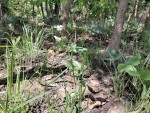
Habit
Degraded miombo woodland
Chililabombwe District
Nov 2025
Photo: Nick Wightman
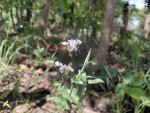
Habit
Degraded miombo woodland
Chililabombwe District
Nov 2025
Photo: Nick Wightman
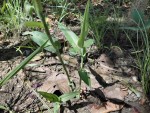
Leaves
Degraded miombo woodland
Chililabombwe District
Nov 2025
Photo: Nick Wightman
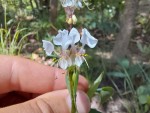
Flowers
Degraded miombo woodland
Chililabombwe District
Nov 2025
Photo: Nick Wightman
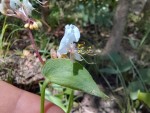
Flowers
Degraded miombo woodland
Chililabombwe District
Nov 2025
Photo: Nick Wightman
Detailed records: Display species records QDS maps by: Google Maps Point records by Google Maps
Species details: Click on each item to see an explanation of that item (Note: opens a new window)
| Synonyms: | |
| Common names: | |
| Frequency: | Locally common |
| Status: | Native |
| Description: |
Perennial; roots relatively few, thick, cord-like or occasionally tuberously thickened; shoots annual, erect to ascending, 8–25(–40) cm tall, sparsely branched, glabrous to puberulous. Leaves distichous; sheaths mostly 1.5–3.5 cm long, sometimes the basal ones longer, usually with a line of hairs along the fused edge, ciliate at the apex, and otherwise glabrous, or occasionally completely glabrous or the whole surface pubescent; lamina lanceolate-oblong to linear, usually broadest at the base, 5.5–15(–22) × (0.25–)0.8–3 cm, base rounded to cordate-amplexicaul, margins scabrid distally, occasionally also ciliate proximally, apex acuminate to attenuate; surfaces usually glabrous, occasionally puberulous. Spathes solitary; peduncles (4–)5.5–11(–18) cm long, glabrous, with a longitudinal line of hairs, or rarely more generally puberulous; spathes not at all to slightly falcate, 3–9(–11) × (0.6–)1–1.5(–1.9) cm, base cordate to deeply cordate or rarely rounded, margins usually ciliate to ciliolate at least proximally, apex usually long-attenuate, sometimes abruptly so, surfaces usually glabrous, occasionally pubescent, sometimes purple, purple-veined or narrowly to broadly purple-margined; upper cincinnus (1–)7–14 flowered, lower cincinnus (4–)10–15-flowered. Flowers bisexual and male, those of the upper cincinnus apparently all male; upper sepal tinged with reddish purple, 4.5–6 mm long, paired sepals tinged with reddish purple, essentially free, 4.5–7 mm long; paired petals usually white, occasionally pink (rarely blue?), 9–14 × 8–10 mm of which the proximally reddish purple claw 4.5–5 mm long; lower petal elliptic or ovate-elliptic, 4.5–8 mm long, concolorous with the paired petals; staminodes 3; lateral stamens with filaments ± 10 mm long, anthers (1.2–)1.6–2.2 mm long, medial stamen with filament 7–9 mm long, anther (1.8–)2–3.2 mm long. Ovary ± 1.5 mm long; style ± 12–13 mm long. Capsules bi- to trilocular, bivalved, 8–9 mm long, rostrate, up to 5-seeded, dorsal locule 1-seeded to abortive, indehiscent, ventral locules 1–2-seeded, the basal ovules sometimes aborting. Ventral locule seeds strongly dorsiventrally compressed, ± reniform to deltate, 2.5–3.5 × 1.9–2 mm, testa blackish, foveolate or foveolate-reticulate. |
| Type location: |
DRC |
| Notes: | |
| Derivation of specific name: | hockii: named after A. Hock, who collected the type specimen in Congo in 1911. |
| Habitat: | Brachystegia woodland and grassland |
| Altitude range: (metres) | 1250 - 2000 m |
| Flowering time: | Nov - Dec |
| Worldwide distribution: | Tanzania, DRC, Zambia and Angola |
| FZ divisions: | N,W |
| Zambian distribution (Provinces): | Nw,Cb,Lp,N |
| Growth form(s): | Perennial. |
| Endemic status: | |
| Red data list status: | |
| Insects associated with this species: | |
| Spot characters: | Display spot characters for this species |
| Images last updated: | Tuesday 17 February 2026 |
| Literature: |
Faden, R. (2012). Commelinaceae Flora of Tropical East Africa Pages 157 - 158. |
Other sources of information about Commelina hockii :
External websites:
African Plants: A Photo Guide (Senckenberg): Commelina hockiiAfrican Plant Database: Commelina hockii
BHL (Biodiversity Heritage Library): Commelina hockii
EOL (Encyclopedia of Life): Commelina hockii
GBIF (Global Biodiversity Information Facility): Commelina hockii
Google: Web - Images - Scholar
iNaturalist: Commelina hockii
IPNI (International Plant Names Index): Commelina hockii
JSTOR Plant Science: Commelina hockii
Mansfeld World Database of Agricultural and Horticultural Crops: Commelina hockii
Plants of the World Online: Commelina hockii
Tropicos: Commelina hockii
Wikipedia: Commelina hockii