Buchnera hirsutorepens
Selected images: Click on each image to see a larger version and details of the record View all images (3)
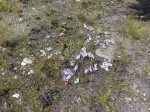
Habit
Dry dambo grassland
Shiwa N'gandu Distr
Feb 2022
Photo: Nick Wightman
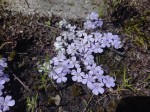
Flowers
Dry dambo grassland
Shiwa N'gandu Distr
Feb 2022
Photo: Nick Wightman
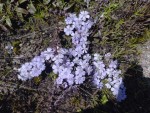
Flowers
Dry dambo grassland
Shiwa N'gandu Distr
Feb 2022
Photo: Nick Wightman
Detailed records: Display species records QDS maps by: Google Maps Point records by Google Maps
Species details: Click on each item to see an explanation of that item (Note: opens a new window)
| Synonyms: |
Buchnera prorepens sensu Philcox |
| Common names: | |
| Frequency: | Occasional |
| Status: | Native |
| Description: |
Prostrate, many stemmed herb arising from a woody tap root. Stems hirsute. Leaves opposite, oblanceolate to narrowly oblong-elliptic, 4 – 41 × 1 – 12 mm, sessile, base attenuate, margin entire, apex obtuse to acute, occasionally mucronate or rounded, surfaces hirsute or strigose, 1 – 3 nerved; distal leaves considered here as bracts. Flowers solitary in axils of leaf-like bracts throughout the majority of the stem, usually pedicel late, rarely sessile; pedicels (0 –) 0.5 – 2 mm long. Bracts 5 – 20 (– 30) × 0.8 – 4.5 (– 8) mm, oblanceolate or rarely narrowly oblong-elliptic, base attenuate, mar gin entire, apex acute to obtuse, rarely mucronate, surfaces hispid or hirsute; bracteoles 3.5 – 9 × 0.2 – 0.6 (– 1.2) mm, linear, apex acute, surfaces hispid or hir sute. Calyx 10-nerved; tube 4.2 – 6.8 mm long, shortly hirsute to densely so externally; lobes 1.3 – 4.6 × 0.3 – 1.4 mm, lanceolate, apex acute, hirsute externally. Corolla lilac; tube 7.5 – 12.6 mm long, 1.5 – 2 (>2) × longer than calyx tube, externally strigose or hirsute, trichomes often most dense adjacent to calyx lobes, glabrous at its base, internally hirsute, densely hispid at mouth; lobes 1.7 – 4.5 (– 6.8) × (0.9 –) 1.4 – 3.3 (– 6.1) mm, obovate to elliptic, glabrous, rarely hirsute or scabrid externally, rarely weakly hirsute on margin. Stamens 4, didynamous, inserted on corolla tube; fila ments glabrous, shorter filaments 0.5 – 1 mm long, longer filaments 0.7 – 3 mm long; anthers 1.1 – 1.7 mm long. Ovary 0.8 – 1.9 mm long; style filiform, (0.5 –) 1.7 – 2.6 mm long; stigma narrowly oblong-elliptic, 0.9 – 1.5 mm long. Capsule c. 2.2 × 1.8 mm, obovoid to cylindrical, glabrous. |
| Type location: |
Mpika Dist., Muchinga Province, Zambia |
| Notes: | B. hirsutorepens was separated from a broader concept of B. prorepens representing an east-west division of B. prorepens sensu lato. See Gibson et al. (2026) Kew Bulletin publication for specific differences. |
| Derivation of specific name: | hirsutorepens: from the latin hirsutus, meaning hairy, and repens, meaning creeping, and referring to the stems. |
| Habitat: | Open sandy and rocky habitats, often on hillsides, savannas |
| Altitude range: (metres) | 1170 - 2000 m |
| Flowering time: | Mar - Jun |
| Worldwide distribution: | South eastern DRC and adjacent central and eastern Zambia |
| FZ divisions: | N,C |
| Zambian distribution (Provinces): | N,Mc,C |
| Growth form(s): | Perennial. |
| Endemic status: | Near Endemic |
| Red data list status: | |
| Insects associated with this species: | |
| Spot characters: | Display spot characters for this species |
| Images last updated: | Thursday 30 July 2026 |
| Literature: |
Gibson, J.K., Sichamba, M. and Darbyshire, I. (2026). Buchnera hirsutorepens, a new species of prostate Orobanchaceae from Zambia and the Democratic Republic of the Congo, along with a revised description of Buchnera prorepens Kew Bulletin 81 Pages 377 - 384. |
Other sources of information about Buchnera hirsutorepens:
External websites:
African Plants: A Photo Guide (Senckenberg): Buchnera hirsutorepensAfrican Plant Database: Buchnera hirsutorepens
BHL (Biodiversity Heritage Library): Buchnera hirsutorepens
EOL (Encyclopedia of Life): Buchnera hirsutorepens
GBIF (Global Biodiversity Information Facility): Buchnera hirsutorepens
Google: Web - Images - Scholar
iNaturalist: Buchnera hirsutorepens
IPNI (International Plant Names Index): Buchnera hirsutorepens
JSTOR Plant Science: Buchnera hirsutorepens
Mansfeld World Database of Agricultural and Horticultural Crops: Buchnera hirsutorepens
Plants of the World Online: Buchnera hirsutorepens
Tropicos: Buchnera hirsutorepens
Wikipedia: Buchnera hirsutorepens